
xAI builds Grok frontier AI models for reasoning, coding, voice, images, video, enterprise workflows, and developer APIs.
34M visits/mo+16.2%#6 Coding & Development

Hands-on course for building and operating production-grade LLM systems
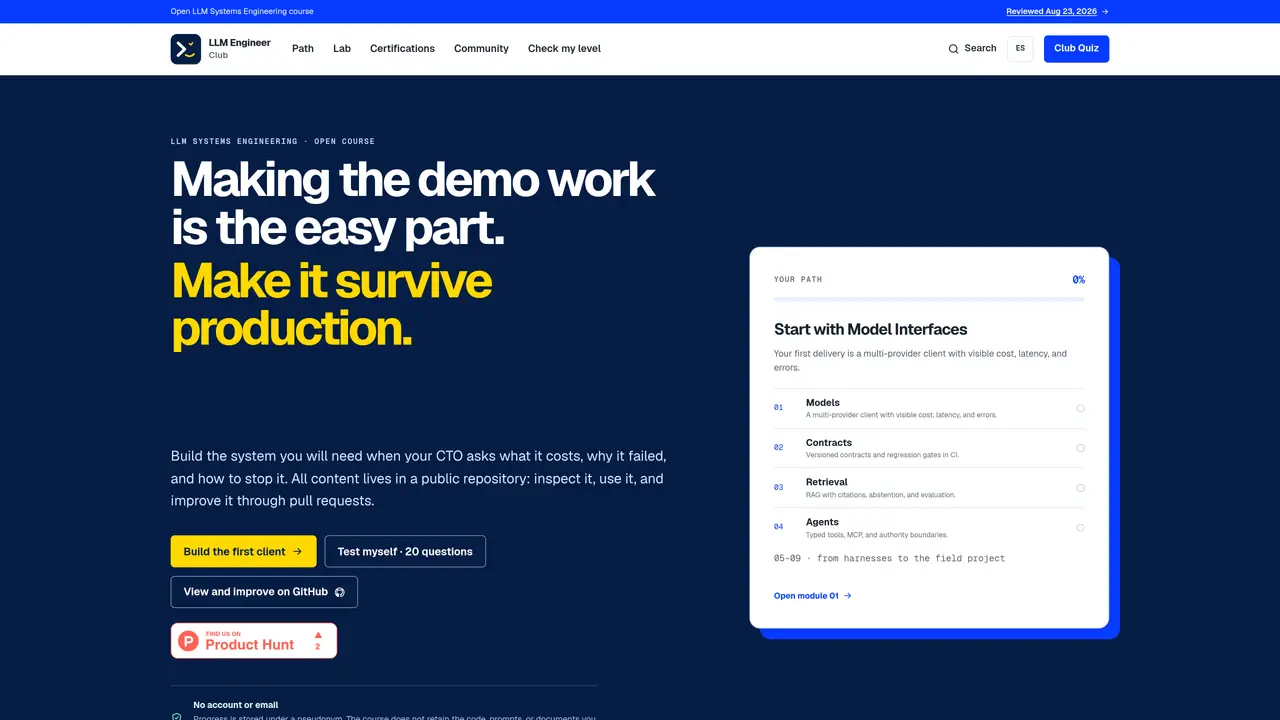
LLM Engineer Club provides a structured path for engineers to learn how to design, build, and deploy reliable LLM systems in production environments. The course begins with model interfaces and progresses through contracts, retrieval, agents, harnesses, loops, graphs, and production engineering before culminating in a field project that another engineer can audit. Each module includes lessons and labs that focus on practical challenges such as managing multi-provider clients, versioned contracts, RAG with citations, typed tools, harness testing through failure injection, loop budgeting, and state management. The curriculum emphasizes observable metrics like cost, latency, and errors while teaching how to implement SLOs, security measures, and runbooks. Content is hosted in a public repository where progress is tracked pseudonymously and no user data is retained. The program also offers a verifiable challenge with private questions to test skills under pressure, as well as mock exams for AWS AI Practitioner and NVIDIA Generative AI LLMs certifications.
LLM Engineer Club is an open course designed for engineers who want to learn how to design, build, and deploy reliable LLM systems in production environments. It provides a structured path from foundational concepts to advanced topics like retrieval, agents, and production engineering.
The course is divided into nine modules, starting with model interfaces and progressing through contracts, retrieval, agents, harnesses, loops, graphs, and production engineering. Each module includes lessons and hands-on labs, culminating in a field project that another engineer can audit.
The course focuses on practical challenges such as managing multi-provider clients, versioned contracts, RAG with citations, typed tools, harness testing through failure injection, loop budgeting, and state management. It also emphasizes observable metrics like cost, latency, and errors.
Yes, the course offers a verifiable challenge with private questions to test skills under pressure, as well as mock exams for AWS AI Practitioner and NVIDIA Generative AI LLMs certifications. Completing the challenge provides a pseudonymous achievement certificate.
Progress is tracked pseudonymously in a public repository where users can inspect, use, and improve content through pull requests. No user data, code, prompts, or documents are retained by the course.
The course includes 12 browser-based tools, such as a document chunking analyzer, a support assistant for policy retrieval, and modules for testing retrieval pipelines and system performance. All tools are designed to simulate real-world scenarios.
llmengineerclub.com · third-party estimates from Similarweb
Share of visits by channel
No measurable traffic from Social, Paid Referrals or Search.
Share of visits · estimated visits
Coding & Development · Sep 2026
Traffic figures are third-party estimates, good for scale and trends; they can differ from a company's own numbers. Updated monthly.
We use essential cookies to run Aitoolnavio, and optional cookies to analyze traffic and measure our marketing. You choose what we use — optional cookies stay off unless you turn them on. See our Privacy Policy.
One short email a week: fresh tools worth trying, honest takes and the updates that actually matter. No spam, unsubscribe any time.
xAI builds Grok frontier AI models for reasoning, coding, voice, images, video, enterprise workflows, and developer APIs.
Open-source backend platform providing Postgres, authentication, APIs, and real-time features to build scalable apps quickly.
Unified platform to access and switch between hundreds of AI models like ChatGPT, Claude, and Gemini via a single API.
Meta AI enhances machine learning, NLP, and computer vision capabilities.
A cloud platform for deploying, scaling, and managing web apps and AI workloads with Git-based CI/CD and edge functions.
AI-powered coding platform that uses agents to plan, write, and test software with real-time feedback and verifiable artifacts.
Chat, build, and explore with open AI models.
Standardize application packaging and execution with portable containers for consistent local and cloud workflows.
Cloud communications platform that lets developers embed SMS, voice, WhatsApp, email, video, verification, and conversational AI via APIs.
Accelerates AI inference, optimizes speed, scalability, cloud-ready.
Open-source platform combining product analytics, session replay, A/B testing, and feature flags in one toolkit for product engineers.
AI-native builder that turns prompts into full-stack web apps, syncs to GitHub, and deploys to Vercel in seconds with visual editing.
Matched on what this tool does — grouped by the job you would be replacing.
matches Multi-provider client with visible cost, latency, and error tracking · Versioned contracts and regression gates in CI · RAG with citations, abstention, and evaluation
TypeScript-native framework for building production-grade AI agents with workflows, memory, and built-in observability.
An AI quality platform for engineering, QA, and product teams to evaluate, monitor, and govern LLM applications with dataset management and production tracing.
Agent observability and evaluation platform for production AI systems
A platform to build, observe, test, and deploy multi-agent AI systems with deep observability and automated safety controls.
matches Harness testing through injected failures · Loop engineering with budgets, stopping, and resumption · Graph engineering for state, knowledge, and provenance
matches RAG with citations, abstention, and evaluation · Graph engineering for state, knowledge, and provenance · Visual drag-and-drop flow builder for AI workflows
A platform for persistent memory, coordination, and crash recovery in multi-agent AI systems.
Open-source agent harness with plugin-based architecture and full traceability
Open-source framework for building resilient, stateful AI agents with graph-based orchestration, durable execution, and human-in-the-loop control.
Visually build, test, and deploy AI agents, RAG workflows, MCP servers, and LLM apps with drag-and-drop flows and reusable components.
Interactive learning platform for building and testing AI agents and swarms in the browser
A no-code/low-code platform for building, testing, and deploying AI agents through visual workflows without deep programming expertise.