Build teams of AI agents that collaborate, automate workflows, and complete complex tasks together.

Wrangler
$10Starting price
0Popularity
About Wrangler
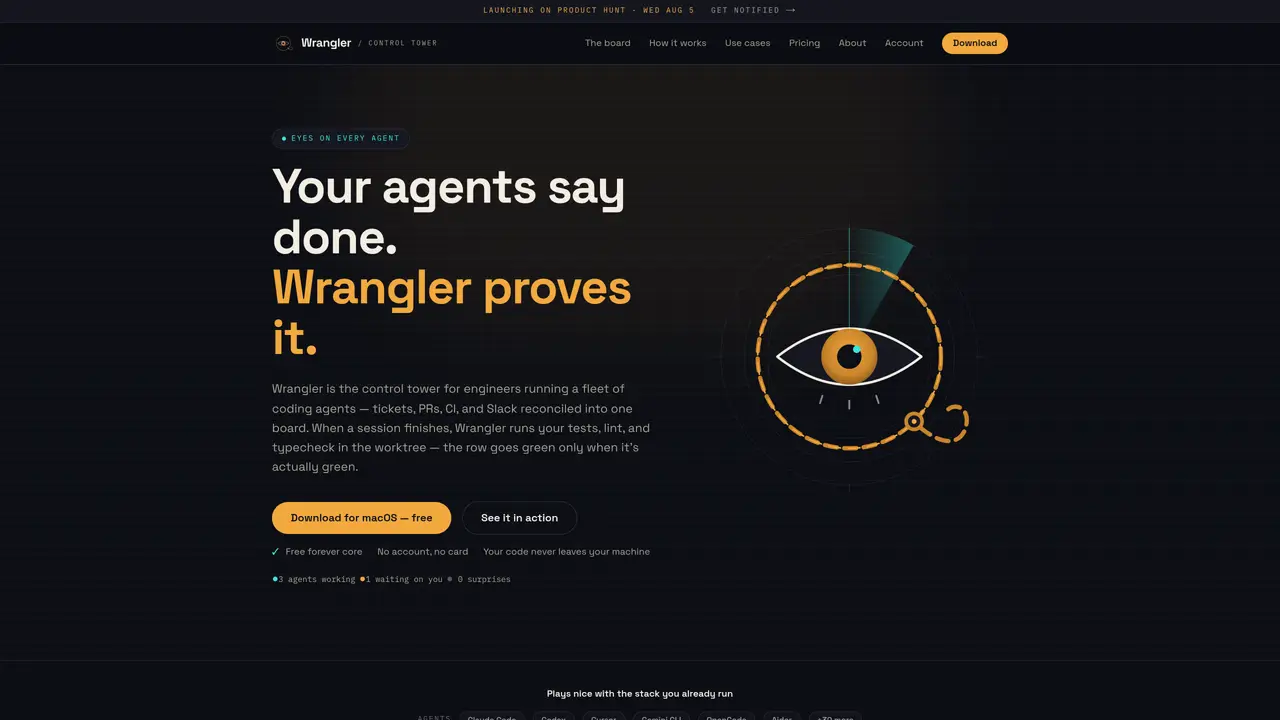
Wrangler is a desktop application that serves as a control tower for engineers managing multiple coding agents. It consolidates tickets, pull requests, CI pipelines, and Slack threads into a single board, reconciling their statuses into one view. When an agent session completes, Wrangler automatically runs tests, linting, and type checking in an isolated git worktree, updating the status only when all checks pass. The tool integrates with existing workflows by connecting to platforms like GitHub, Linear, Jira, and Slack, while keeping code and tokens local to the user’s machine. It supports over 30 coding agents including Claude Code, Cursor, and Gemini, and provides real-time notifications for sessions that require user input or have failed checks. The interface prioritizes minimizing context switching by surfacing only what needs attention, with a ‘Needs you now’ queue for blocked sessions. Users can review and approve changes directly within the app, with options to re-run CI or reply in Slack without leaving the workflow.
Key features
- Single board reconciling tickets, PRs, CI, and Slack threads
- Automated verification of agent outputs in isolated worktrees
- Real-time 'Needs you now' queue for blocked sessions
- Support for over 30 coding agents (Claude Code, Cursor, Gemini, etc.)
- Integration with GitHub, Linear, Jira, Slack, Coralogix, and LaunchDarkly
- Local-first with tokens stored in OS keychain
- One-click actions for approving PRs, re-running CI, or replying in Slack
- Live terminal access within sessions for direct interaction
Use cases
- Managing multiple coding agents working on different features simultaneously
- Coordinating PR reviews and CI checks across multiple repositories
- Reducing context switching by consolidating agent outputs into a single view
Pros
- Consolidates multiple coding agents and their outputs into a single board
- Runs automated verification (tests, lint, typecheck) in isolated worktrees
- Local-first architecture with code and tokens remaining on the user's machine
- Real-time notifications and a priority queue for sessions requiring user input
- Supports over 30 coding agents and integrates with GitHub, Linear, Jira, and Slack
Cons
- macOS-only application
- Free tier limited to 3 concurrent agents
- No cloud-based version available
Frequently asked questions about Wrangler
What is Wrangler and who is it designed for?
Wrangler is a desktop control tower for engineers managing multiple coding agents. It consolidates tickets, pull requests, CI pipelines, and Slack threads into a single board, designed for developers who run parallel agent sessions and need to reconcile their statuses efficiently.
How does Wrangler integrate with existing workflows?
Wrangler connects to platforms like GitHub, Linear, Jira, Slack, Coralogix, and LaunchDarkly using existing credentials stored locally in the OS keychain. It does not replace existing tools but orchestrates them, handling isolation and interruptions.
What happens when a coding agent session completes in Wrangler?
When a session finishes, Wrangler automatically runs tests, linting, and type checking in an isolated git worktree. The status updates only when all checks pass, ensuring the board reflects an accurate health status.
How does Wrangler notify users about sessions that need attention?
Wrangler sends native notifications and chimes when a session finishes or requires input. It also maintains a 'Needs you now' queue that ranks blocked sessions by urgency, surfacing the longest-waiting first.
Can I review and approve changes directly within Wrangler?
Yes, users can review diffs, attach line comments, and approve changes directly in the app. The review queue allows sweeping through open pull requests in one pass, with options to re-run CI or reply in Slack without leaving the workflow.
Is Wrangler free to use and what are the core limitations?
Wrangler offers a free core version with no account or card required. The tool is local-first, meaning your code and tokens never leave your machine. The core version supports up to three agents, with additional capabilities available in other tiers.