
Summarizes, extracts, and rewrites content from files.

PixelRAG
27KMonthly visits
24Popularity
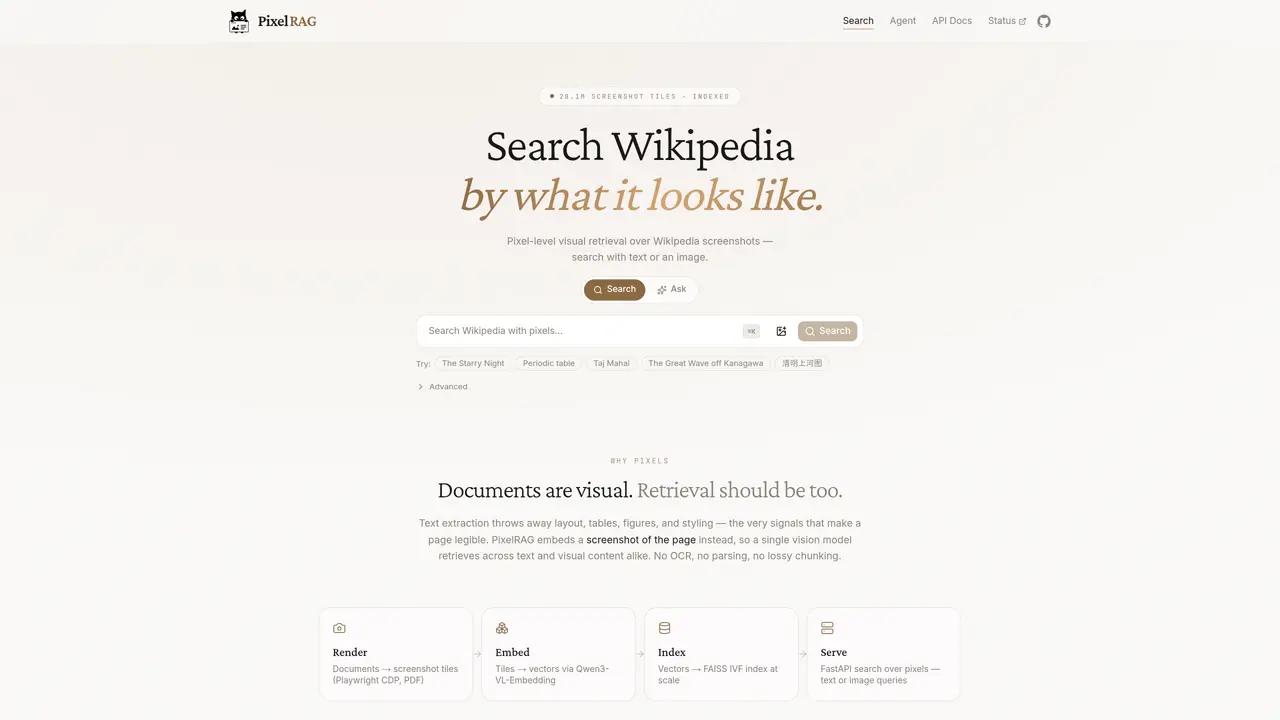
About PixelRAG
PixelRAG is an open-source visual retrieval-augmented generation (RAG) system designed for AI engineers, RAG builders, and developers working with visually complex documents. It renders web pages, PDFs, images, tables, charts, and layouts into screenshot tiles instead of flattening them into plain text, preserving visual structure and context that text-only parsers often discard. The tool supports both hosted and local workflows: users can query a hosted visual Wikipedia index via text, image, or hybrid multimodal queries, or build custom local indexes using rendering, chunking, embedding, FAISS indexing, and serving pipelines. PixelRAG integrates with agent frameworks through a plain HTTP API, enabling AI agents to perform visual retrieval, fetch relevant screenshot tiles, and answer questions based on what the page visually shows. It is particularly useful for document AI teams, knowledge-base builders, research labs, and enterprises handling visually rich content such as dashboards, scientific papers, or web documents. The system emphasizes preserving tables, charts, diagrams, and layout signals that standard text parsers typically lose, making it suitable for applications requiring accurate visual context in retrieval tasks.
Key features
- Renders documents into screenshot tiles instead of text chunks
- Preserves tables, charts, diagrams, and visual layout in retrieval
- Hosted visual Wikipedia search API with text, image, or hybrid queries
- Local indexing with rendering, embedding, FAISS, and serving pipelines
- HTTP API for integration with agent frameworks and custom workflows
- Supports multimodal queries combining text and visual inputs
- Compatible with vision-language models (VLMs) for visual context reading
- Open-source with Python package installation and local pipeline options
Use cases
- Building visual RAG systems for web pages, PDFs, and visually complex documents
- Retrieving screenshot tiles from large document collections or visual knowledge bases
- Enabling AI agents to access and reason over page content through visual retrieval
Pros
- Preserves visual structure and context of documents such as tables, charts, diagrams, and layouts
- Supports both hosted and local workflows for flexibility in deployment
- Enables multimodal queries using text, images, or hybrid inputs
- Integrates with agent frameworks via a plain HTTP API for seamless automation
- Designed for visually complex documents where text-only parsers fall short
Cons
- Requires technical expertise to set up and customize local workflows
- Hosted services may have usage limits or latency considerations
- Not optimized for purely text-heavy documents without visual elements
Frequently asked questions about PixelRAG
What is PixelRAG and what does it do?
PixelRAG is an open-source visual retrieval-augmented generation (RAG) system that converts web pages, PDFs, images, and other visually complex documents into screenshot tiles. It preserves visual structure and context, enabling more accurate retrieval and generation compared to text-only parsers.
Who is PixelRAG designed for?
The tool is designed for AI engineers, RAG builders, document AI teams, knowledge-base developers, research labs, and enterprises working with visually rich content such as dashboards, scientific papers, or web documents.
Can PixelRAG be used locally or only hosted?
PixelRAG supports both hosted and local workflows. Users can query a hosted visual Wikipedia index or build custom local indexes using rendering, chunking, embedding, FAISS indexing, and serving pipelines.
Does PixelRAG support multimodal queries?
Yes, PixelRAG enables multimodal queries, allowing users to search using text, images, or a combination of both.
How does PixelRAG integrate with other tools or frameworks?
PixelRAG integrates with agent frameworks through a plain HTTP API, enabling AI agents to perform visual retrieval, fetch relevant screenshot tiles, and answer questions based on visual context.
What types of documents is PixelRAG best suited for?
PixelRAG is particularly useful for documents where visual context is critical, such as dashboards, scientific papers, web pages, charts, tables, and diagrams. It is less suited for purely text-heavy documents.
PixelRAG Website Engagement
Last Update: 10 days ago
Total Monthly Visits
0
Bounce Rate
0%
Visit Duration (avg)
0.00s
Pages Per Visit
0
Country Rank
0
United States
Global Rank
0
Monthly Traffic
Traffic Sources
Traffic Share By Country
- United States29.9%
- Thailand12.1%
- Vietnam11.8%
- India11.4%
- Indonesia6.1%