
Summarizes, extracts, and rewrites content from files.

KitabiAI
0Popularity
About KitabiAI
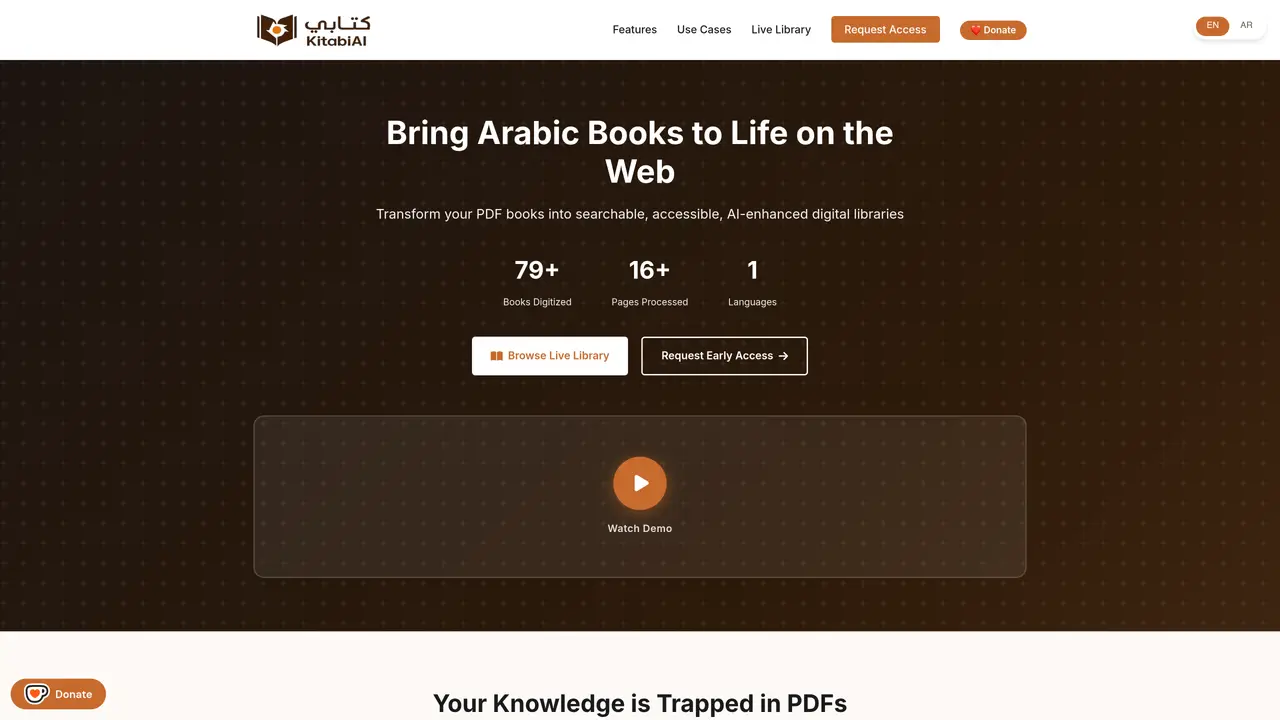
KitabiAI transforms static PDF books into web-based digital libraries that are searchable, accessible, and enhanced with AI capabilities. The platform extracts and structures content from PDFs, converting them into interactive web pages with automatic table of contents, bilingual support, and RTL rendering for Arabic text. It enables readers to ask questions about the book’s content, receiving answers with source citations powered by GPT-4o-mini and pgvector. The tool also generates AI-driven summaries for sections and entire books, optimizing metadata for search engines. Structured content can be exported in multiple formats, including HTML, Markdown, and JSONL, with storage provided in Azure Blob Storage. The platform is designed for authors, universities, and libraries seeking to increase visibility, improve accessibility, and preserve knowledge in digital formats.
Key features
- AI-enhanced searchable digital libraries
- Automatic table of contents extraction
- RTL support for Arabic text
- AI chat with source citations
- AI-generated summaries and metadata
- Multi-format export options
- SEO-optimized web pages
- Azure Blob Storage integration
Use cases
- Digitizing Arabic book collections for global access
- Preserving and sharing academic research archives
- Enhancing discoverability of authors' works through interactive web versions
Pros
- AI-powered chat with source citations
- Bilingual support including Arabic RTL rendering
- Automatic SEO optimization and metadata generation
- Multi-format export (HTML, Markdown, JSONL)
- Structured content extraction from PDFs
Cons
- No free tier or self-service access
- Limited to PDF input format
- Requires early access request for institutional use
- Currently supports only two languages
Frequently asked questions about KitabiAI
What does KitabiAI do?
KitabiAI converts static PDF books into web-based digital libraries that are searchable, accessible, and enhanced with AI capabilities. It extracts and structures content from PDFs, enabling features like automatic table of contents, bilingual support, RTL rendering for Arabic text, and AI-powered Q&A with source citations.
Who is KitabiAI designed for?
The platform is designed for authors, universities, and libraries seeking to increase visibility, improve accessibility, and preserve knowledge in digital formats. It supports digitizing research archives, academic collections, and Arabic books while enabling global reach and 24/7 access.
How does the AI Assistant feature work?
The AI Assistant allows readers to ask questions about a book’s content, receiving answers sourced directly from the text with citations. It is powered by GPT-4o-mini and pgvector, ensuring accurate and contextually relevant responses.
What formats can the structured content be exported in?
Structured content can be exported in multiple formats, including HTML, Markdown, and JSONL. Exported files are automatically stored in Azure Blob Storage for easy access and management.
Does KitabiAI support Arabic text?
Yes, KitabiAI includes full support for Arabic text, including RTL rendering, bilingual capabilities, and processing for Arabic books. It has already digitized over 90 Arabic books with structured sections and AI summaries.
How can I get started with KitabiAI?
Prospective users can request early access by filling out a form on the website, specifying details such as the number of books and preferred language. Alternatively, they can email hello@kitabiai.com to discuss digitizing their collection.