
Automate tasks on websites with Browser-Use's AI browser control.

Aartiq
FreeStarting price
0Popularity
About Aartiq
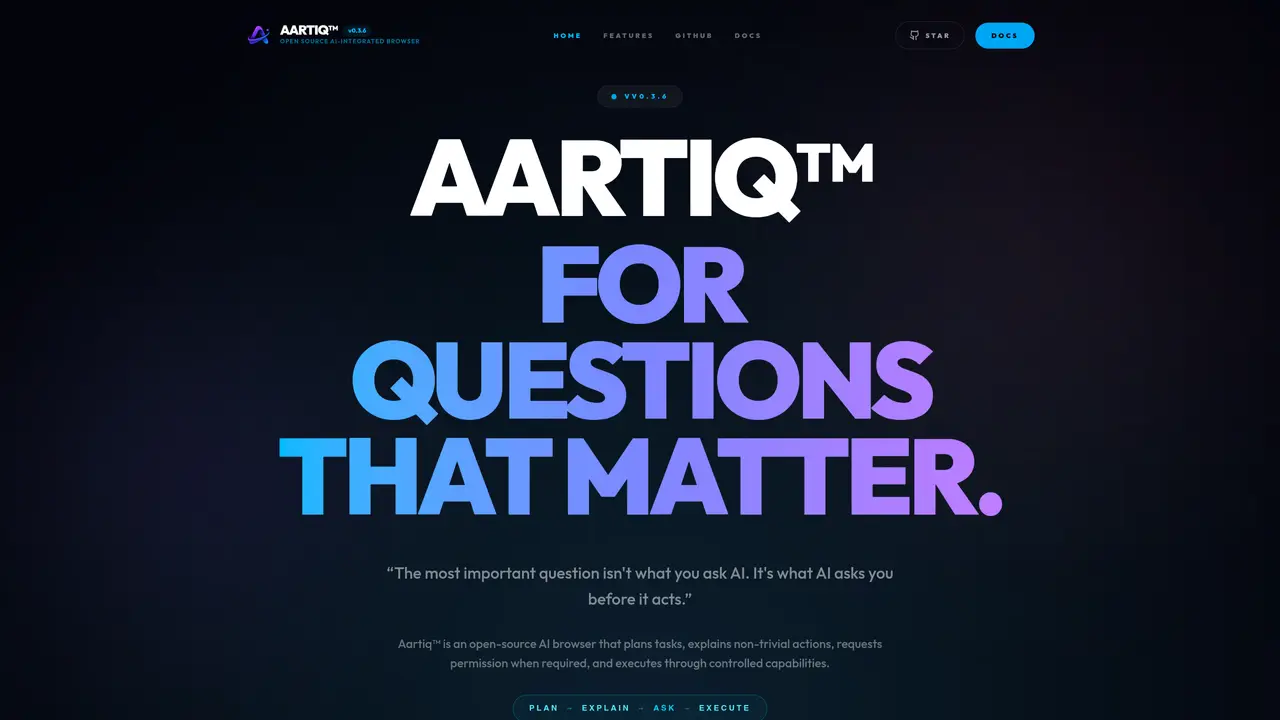
Aartiq is an open-source AI-integrated browser designed to plan, explain, request permission, and execute tasks through controlled capabilities. It operates on a loop of understanding, planning, explaining, asking, executing, and returning results, with explicit user permission boundaries enforced at each step. The browser integrates local large language models to handle multi-step tasks, document generation, visual analysis via OCR, and system-level automation while maintaining inspectable security policies. Capabilities are gated by registered policies rather than prompt wording, and user-controlled permissions define what actions are allowed. The system includes an encrypted local vault for secrets, directory isolation, and continuous verification through automated tests and CI pipelines. Security is enforced through a three-layer model and threat-tested scenarios, including resistance to webpage-derived instruction attacks.
Key features
- Multi-step task planning with RAG memory
- Document generation from PDF, Excel, or PPTX files
- Visual analysis via OCR and screenshot processing
- Filesystem isolation with explicit directory boundaries
- Encrypted local vault for secure credential storage
- Three-layer security model with capability gating
- Cross-platform support across major operating systems
- Continuous CI verification and automated testing
Use cases
- Automating file management tasks with explicit permission checks
- Generating reports or documents from existing files
- Performing system-level automation with user oversight
Pros
- Open-source and fully inspectable source code
- Explicit user permission boundaries for all actions
- Local LLM integration for task planning and execution
- Encrypted local vault for credentials and secrets
- Multi-platform support including macOS, Windows, Linux, and Android
Cons
- Development currently paused by founder
- Limited contributor activity (no pull requests yet)
- No documented cloud-based or collaborative features
- Hardware requirements not specified beyond Electron compatibility
Aartiq videos
Frequently asked questions about Aartiq
What is Aartiq and what does it do?
Aartiq is an open-source AI-integrated browser that plans, explains, requests permission, and executes tasks through controlled capabilities. It operates in a loop of understanding, planning, explaining, asking for permission, executing, and returning results, with explicit user permission boundaries enforced at each step.
Who should use Aartiq?
Aartiq is designed for users who need a secure, inspectable AI agent that respects user-defined boundaries and asks for permission before performing consequential actions. It is particularly useful for tasks requiring multi-step automation, document generation, or system-level operations.
How does Aartiq handle security and permissions?
Aartiq enforces security through a three-layer model, capability-gated actions, and user-controlled permissions. It does not treat webpage-derived instructions as authorization for privileged capabilities and explicitly asks for user permission before executing any consequential step.
Can Aartiq run offline or with local models?
Yes, Aartiq integrates local large language models to handle tasks such as multi-step planning, document generation, and visual analysis via OCR. It operates with local processing to maintain inspectability and security.
What platforms does Aartiq support?
Aartiq supports multiple platforms including macOS, Windows, Linux, and Android. It is built with Electron for cross-platform compatibility and includes platform-specific integrations.
How can I get started with Aartiq?
To get started, visit the Aartiq GitHub repository or documentation to download and set up the browser. Follow the MCP setup guide and review the security model and threat model documentation to understand its capabilities and limitations.