
Meta AI enhances machine learning, NLP, and computer vision capabilities.

Filesystem MCP
$0.07Starting price
0Popularity
About Filesystem MCP
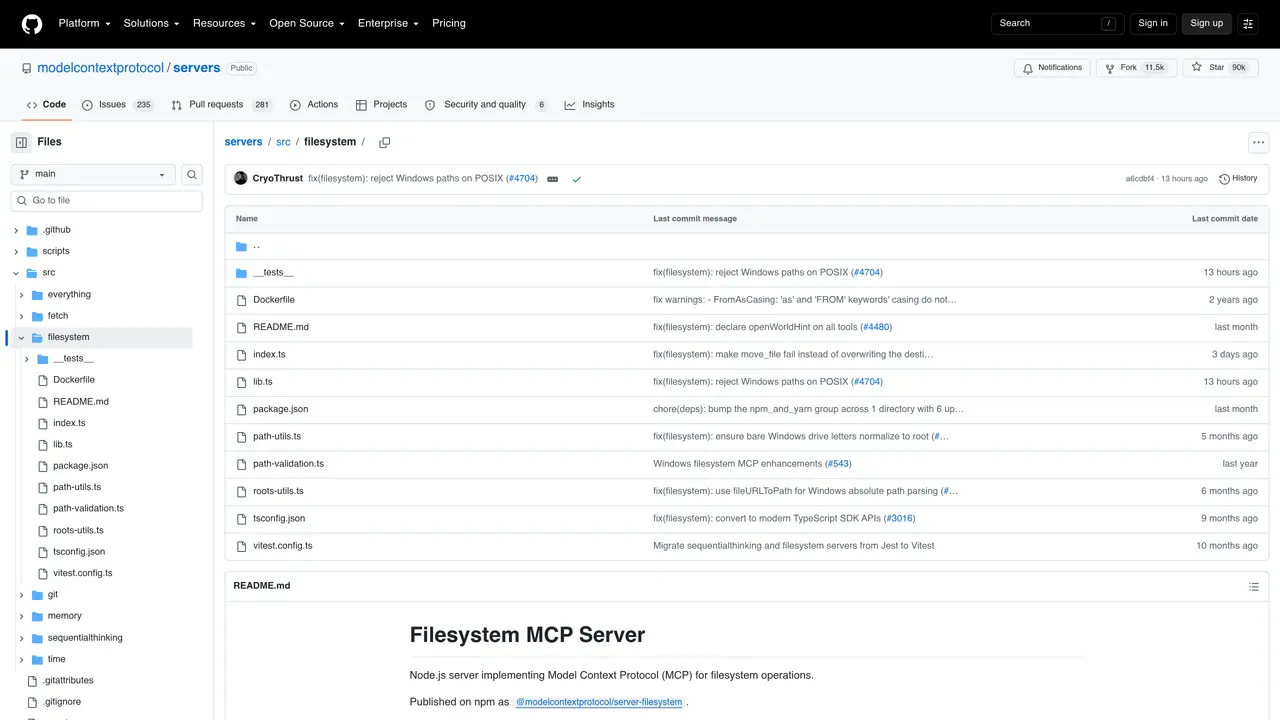
The Filesystem MCP server bridges local files and directories to AI coding assistants like Cursor, Claude Desktop and Windsurf. It exposes a standardized Model Context Protocol interface so these tools can read, write, search and manipulate files on the user’s machine without requiring manual file uploads. The server runs locally and requires no external dependencies beyond a standard Node.js runtime. It is designed for developers who want to automate file operations or enable AI assistants to interact directly with their project files. Typical workflows include code review, refactoring, documentation generation and batch file processing. The server supports common filesystem operations such as listing directories, reading and writing files, searching for text patterns and managing file metadata.
GitHub, Inc.
San Francisco, California, US · Founded 2008
- Founders
- Tom Preston-Werner, Chris Wanstrath, PJ Hyett, Scott Chacon
- Founded
- 2008
- Headquarters
- San Francisco, California, US
- Legal status
- Subsidiary of Microsoft (NASDAQ: MSFT)
Key features
- Expose local files and directories via Model Context Protocol
- Support read, write, search and metadata operations
- Run locally with Node.js runtime
- Integrate with Cursor, Claude Desktop and Windsurf
- No external dependencies required
- Standardized MCP interface for interoperability
Use cases
- Enable AI assistants to review and edit local codebases
- Automate file-based tasks like refactoring or documentation updates
- Search and analyze project files without manual uploads
Pros
- Enables direct filesystem interaction for AI coding assistants via the Model Context Protocol
- Supports dynamic directory access control through Roots protocol for flexible runtime updates
- Operates locally with minimal dependencies, requiring only a standard Node.js runtime
- Provides standardized tools for reading, writing, searching, and managing files and directories
- Allows granular file operations including text extraction, media reading, and metadata access
Cons
- Requires at least one explicitly allowed directory to function, limiting default access
- Fallback behavior without Roots support restricts dynamic directory updates
- Initialization fails if no directories are specified and Roots are not supported by the client
Frequently asked questions about Filesystem MCP
What is the Filesystem MCP server used for?
The Filesystem MCP server bridges local files and directories to AI coding assistants, enabling them to read, write, search, and manipulate files on the user’s machine without manual uploads.
Who should use the Filesystem MCP server?
It is designed for developers who want to automate file operations or enable AI assistants to interact directly with their project files for tasks like code review, refactoring, or documentation generation.
How does directory access control work?
Directories can be specified via command-line arguments or dynamically via the Roots protocol, which allows clients to update allowed directories at runtime without restarting the server.
What happens if no directories are specified and Roots are not supported?
The server will throw an error during initialization, as it requires at least one allowed directory to operate.
Does the server support reading media files like images or audio?
Yes, the server includes a tool to read media files and return them as base64-encoded content with their MIME type.
How do I get started with the Filesystem MCP server?
Install the server via npm as @modelcontextprotocol/server-filesystem and configure allowed directories either through command-line arguments or the Roots protocol when connecting with an MCP client.